One hand. Three familiar lines. A question you may never have thought to ask.**
Hold your palm up in the light. The creases have been there for so long that you probably stopped seeing them. Yet no two hands present quite the same map. In palm reading, the first step is not to search for a prediction. It is to notice the pattern in front of you.
In brief: To read your palm, start with both hands in good light. Find the heart line beneath the fingers, the head line across the middle, and the life line curving around the thumb. Traditional palmistry gives these lines symbolic meanings connected with feeling, thought and vitality. Read their shape and relationship together; a single line cannot establish your personality, health or future.
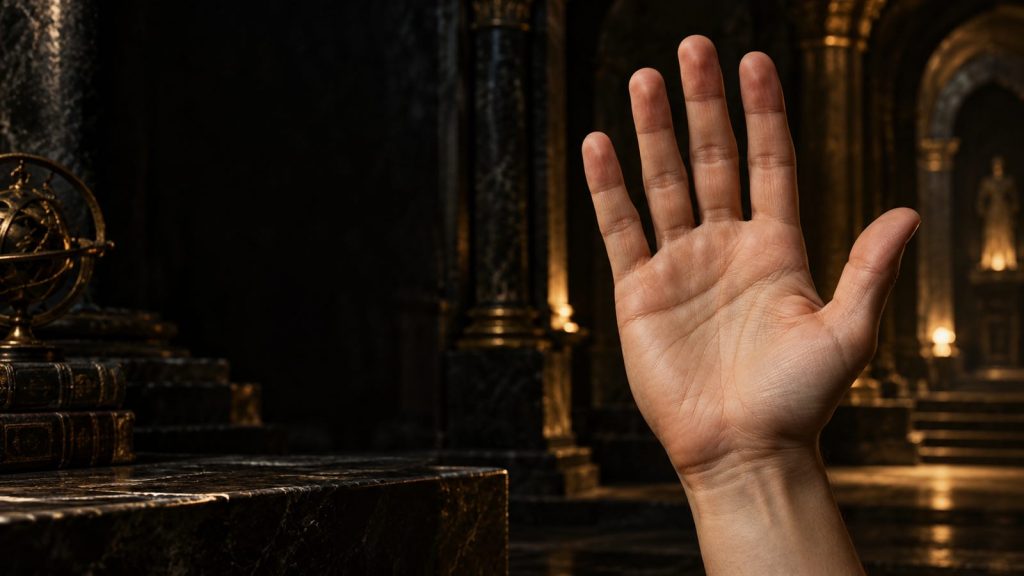
The Eastern Archive visualisation. Generated editorial image; it is not a photograph of a reading client.*
What is palm reading?
Palm reading, also called palmistry or chiromancy, is the practice of interpreting the shape, lines and features of a hand. Different traditions have developed different rules. The Eastern Archive uses the hand as an invitation to examine patterns and ask better questions about yourself.
There is a useful distinction here. Palmar creases are real anatomical features; the meanings assigned to them in palmistry are traditional interpretations. A crease does not scientifically establish that someone will fall in love, become wealthy or live to a certain age. The interesting part of a reading is how several details form a story worth reflecting on.
Which hand should you read?
Start with both. Some palmistry traditions give the dominant hand more weight when discussing current habits and lived experience, and the non-dominant hand more weight when discussing inherited tendencies or potential. This is a reading convention, not a biological rule. Other readers use different systems, including left and right hand rules.
Place your hands side by side. Are the main lines similarly shaped? Does one appear clearer? Before attaching a meaning, check the lighting and whether both hands are equally relaxed. The comparison is often more revealing than an isolated feature.
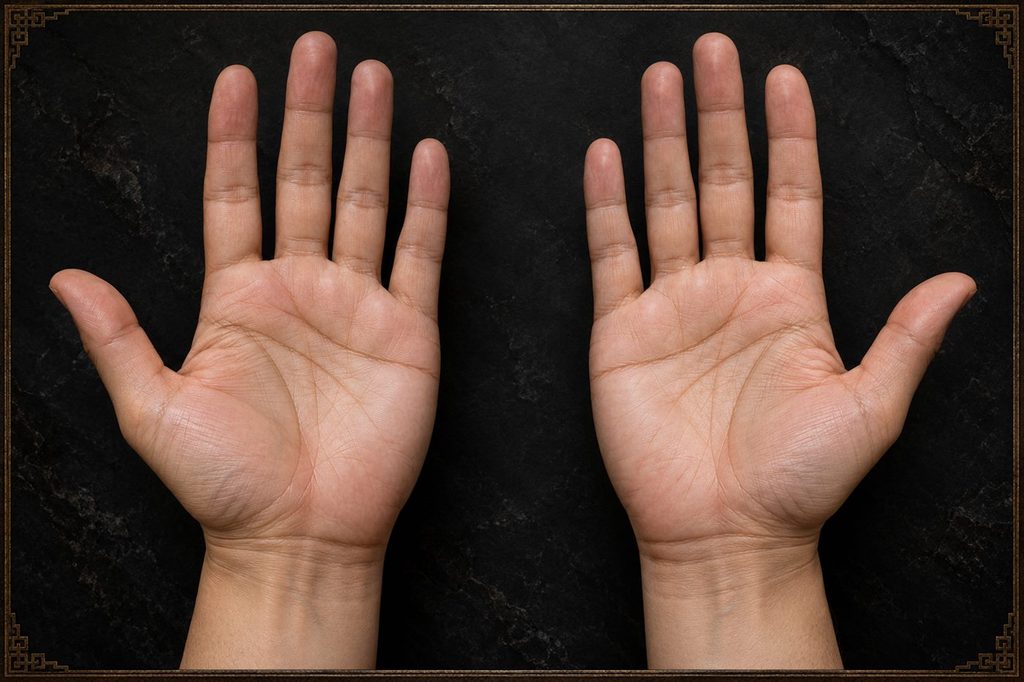
Compare the same area on each hand. Generated editorial image for orientation, not a diagnostic chart.
How to read your palm in five steps
- Find even light. Open your hand naturally. Strong shadows and a tightly stretched palm can make fine lines look different.
- Locate the three main lines. Begin with the heart, head and life lines described below. Some hands also show a vertical fate line.
- Describe before interpreting. Is a line long or short, straight or curved, deep or faint, continuous or interrupted? Write down what you can actually see.
- Look at relationships. Where do lines begin, meet or separate? Compare the corresponding feature on your other hand.
- Ask a useful question. If a traditional reading suggests caution, independence or emotional openness, does that resonate with your experience? Where does it fail to fit?
This order matters. A quick online diagram can help you name a line, but the rest of the hand supplies its context.
The three major palm lines and their traditional meanings
Heart line: feeling and relationships
The heart line usually runs across the upper palm, below the fingers. In palmistry it is associated with emotional expression, intimacy and the way a person approaches relationships. Readers may consider its curve, depth and endpoint. A curved line is often described as expressive; a straighter one as more reserved or deliberate. These are symbolic readings, not personality test results.
Head line: thought and decisions
The head line runs across the middle of the palm, often beginning near the thumb and index finger. Traditional readings connect it with thinking style, attention and decision-making. A straighter path is commonly read as practical; a downward slope as imaginative or intuitive. Notice whether it begins joined to the life line or apart from it, but resist turning one small gap into a fixed verdict about your character.
Life line: vitality and lived experience
The life line arcs around the base of the thumb. It is one of the most searched and most misunderstood palm lines. In many palmistry traditions, it is read in relation to vitality, grounding and changes in life. Its length does not tell you how long you will live. A short or broken life line is not a medical finding or a countdown.
What about the fate line?
Some people have a noticeable vertical fate line rising through the centre of the palm; others do not. Traditional readers often connect it with direction, work or outside influences. Its absence is ordinary and does not mean a person lacks purpose or a career path.
What if your palm does not match a diagram?
That is common. Lines can be faint, branched, joined or difficult to separate. A line may look entirely different when the light changes. Some people have a single prominent crease crossing the palm where two major creases are usually described. The anatomical term is single palmar crease; it occurs in people who are otherwise healthy, though a clinician may consider it alongside other findings in a medical context. It is not something a palm reading can diagnose. MedlinePlus explains the anatomy.
The Archive’s rule is simple: observe the hand you have, rather than forcing it into a perfect diagram. The variations are often where a personal reading begins.
Can palm reading tell your future?
Palmistry has long used the language of possibility and destiny. That mystery is part of its appeal. But there is no sound basis for treating a line as a guaranteed forecast of marriage, money, illness or lifespan. We use traditional meanings as prompts for reflection: a way to notice what feels familiar, what has changed and what you may want to examine more closely.
A useful reading leaves you with more agency, not less. If an interpretation does not fit your life, you are allowed to set it aside.
Begin with your own hand
Look again at both palms. Find the three main lines. Choose one detail that stands out, and ask what it brings to mind. You do not need to decode your entire life in one sitting.
If you would like a closer look, begin a free hand observation. The Eastern Archive’s first observation focuses on one visible detail in the photographs you share and returns a short personal PDF. It is an invitation to explore your pattern, not a verdict on your future.
Frequently asked questions
Is palm reading the same as palmistry?
Yes. Palm reading is the everyday term; palmistry is the name commonly used for traditions that interpret the hand. Chiromancy is another term you may encounter.
Which palm line is the most important?
There is no universal answer. Beginners usually start with the heart, head and life lines because they are easier to identify. A thoughtful reading considers how features relate to one another.
Do palm lines change over time?
The appearance of fine creases can vary with lighting, skin condition and the way you hold your hand. If you want to compare over time, photograph both palms in similar light and position. Do not treat an apparent change as a health diagnosis or a guaranteed sign of an event.
Does a short life line mean a short life?
No. A life line’s length cannot predict lifespan. If you have a health concern, use qualified medical advice rather than a palm interpretation.
Editorial note: Traditional meanings in this guide describe palmistry conventions, not established scientific links between palm creases and personality or future events. The generated images illustrate the reading process and are not client evidence. This article should be reviewed and dated by the EA editorial team before publication.